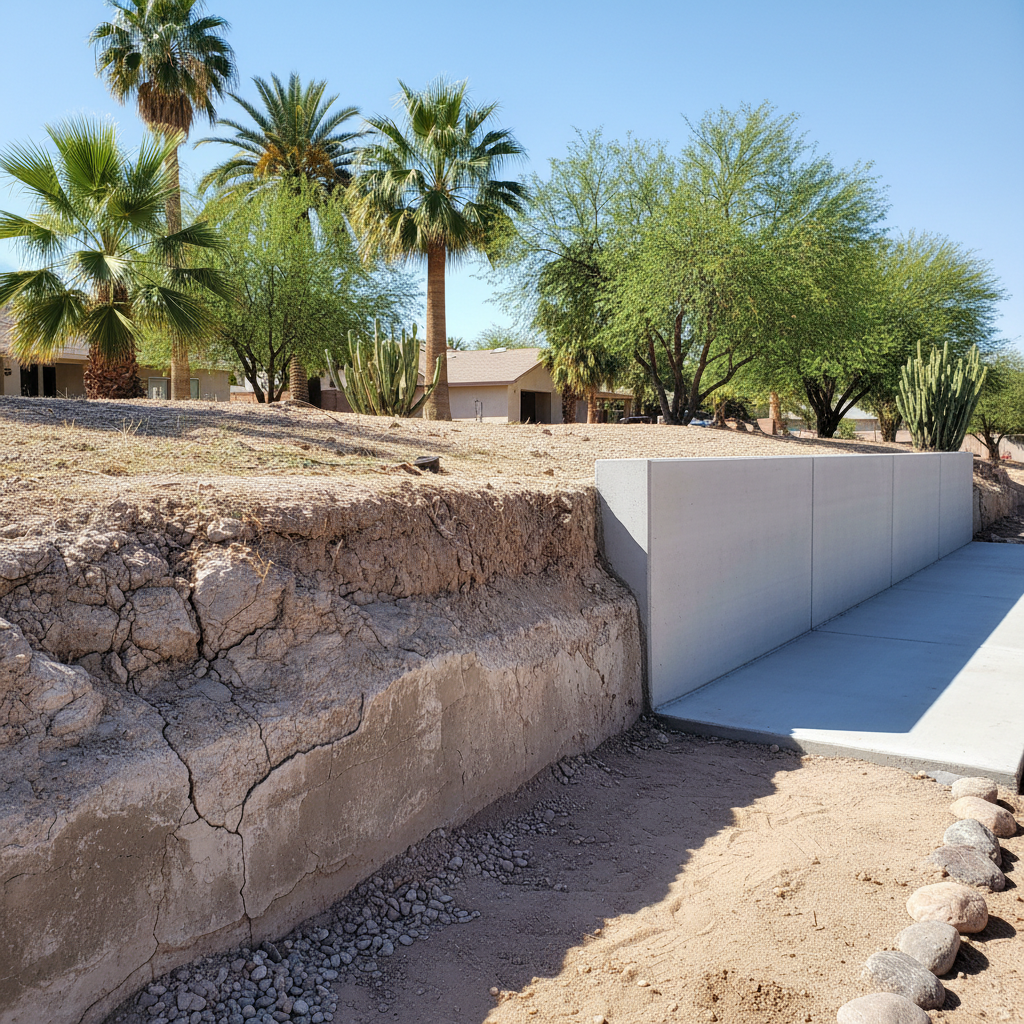
Alright, let's talk retaining walls. If you've got a sloped yard, or you're trying to create a level space, you're probably looking at putting one in. Here in Bullhead City, with our varied terrain – from the flat riverfront properties to those hillside homes in places like Fox Creek – retaining walls are pretty common. But when it comes to concrete, you've generally got two main ways to go: a solid, poured concrete wall or one built with concrete blocks. I see folks wrestling with this choice all the time, so let's clear it up.
Poured Concrete Retaining Walls: The Solid Choice
When I say 'poured concrete,' I'm talking about a wall that's essentially one big, solid piece. We dig a trench for the footing, set up rebar for reinforcement, build forms, and then pour the concrete right into those forms. Once it cures, you've got a monolithic structure. Think of it like a mini dam holding back your soil.
The Good Stuff:
- Unmatched Strength and Durability: This is where poured concrete really shines. Because it's one solid piece, especially with rebar running through it, it's incredibly strong. It can handle a lot of pressure from the soil, which is crucial in places where you might get heavy monsoon rains that saturate the ground and increase soil weight. If done right, it's built to last for decades, often outliving the house itself.
- Design Flexibility: You can pretty much mold poured concrete into any shape you want. Curves, angles, steps – it's all possible, really. You can also get different finishes, from smooth to textured, or even stamped to mimic stone or brick.
- Low Maintenance: Once it's in, it's pretty much set and forget. You might need to clean it occasionally, but structural maintenance is rarely an issue.
The Not-So-Good Stuff:
- Higher Upfront Cost: Generally, a poured concrete wall is going to cost more than a block wall. There's more labor involved with excavation, formwork, rebar tying, and the concrete itself.
- Longer Installation Time: Setting forms, pouring, and then waiting for the concrete to cure takes time. It's definitely not a quick weekend project.
- Less DIY-Friendly: This is absolutely a job for the pros. Getting the forms right, ensuring proper rebar placement, and managing the pour is complex.
Concrete Block Retaining Walls: The Modular Approach
These are the walls you see built with individual, interlocking concrete blocks. They come in various sizes and styles, and they're stacked up, often with a geogrid reinforcement laid between courses for taller walls. They rely on their weight and interlock to hold the soil back.
The Good Stuff:
- Lower Cost: Typically, block walls are more budget-friendly. The materials are often cheaper, and the installation can be less labor-intensive than pouring concrete.
- Faster Installation: Stacking blocks is generally quicker than building forms and pouring concrete.
- DIY Potential: For smaller, shorter walls, some handy homeowners might tackle a block wall themselves. Though for anything significant, I still recommend a pro.
- Variety of Styles: Blocks come in a huge range of colors, textures, and shapes, so you can get a really attractive finished look that blends with your landscaping.
The Not-So-Good Stuff:
- Less Strength for Tall Walls: While good for shorter walls, block walls generally don't have the same sheer strength as a reinforced poured wall, especially for taller applications or heavy soil loads. They often require extensive geogrid reinforcement to achieve similar stability.
- More Joints, More Potential for Movement: All those individual blocks mean a lot of joints. Over time, with ground movement or significant water saturation, you can sometimes see more shifting or bulging compared to a solid poured wall.
- Weed Growth: Those joints can also become prime spots for weeds to sprout if not properly maintained.
So, Which One for Bullhead City?
Here's my take, especially considering our local conditions. We've got a lot of sandy, sometimes silty soil, and while it drains well, when it does get saturated – like during a good monsoon storm – it can get heavy. Plus, we're in an active seismic zone, even if it's usually minor. That means you want something that's going to hold up without a lot of fuss.
For most significant retaining wall projects in Bullhead City, especially anything over three or four feet tall, or if you're holding back a substantial amount of soil, I'm going to lean towards a poured concrete wall every time.
Why? That sheer strength and monolithic structure. You're not going to worry about individual blocks shifting or the wall bulging under pressure from saturated soil. It's built to withstand the elements and the test of time, which means fewer headaches and repairs down the road. You pay a bit more upfront, but you get a wall that's truly a permanent solution.
Now, if you're just doing a small, decorative garden bed, or a very short terracing wall (say, under 2-3 feet), then a concrete block wall can be a perfectly fine, more affordable option. It'll get the job done and look good doing it.
But for anything structural, anything that's really holding back a slope or a significant amount of earth, the durability and stability of a reinforced poured concrete wall are just hard to beat. You're making an investment in your property's stability and aesthetics, and you want that investment to last. That's where Top Notch Concrete Solutions comes in – we build walls that stand strong.