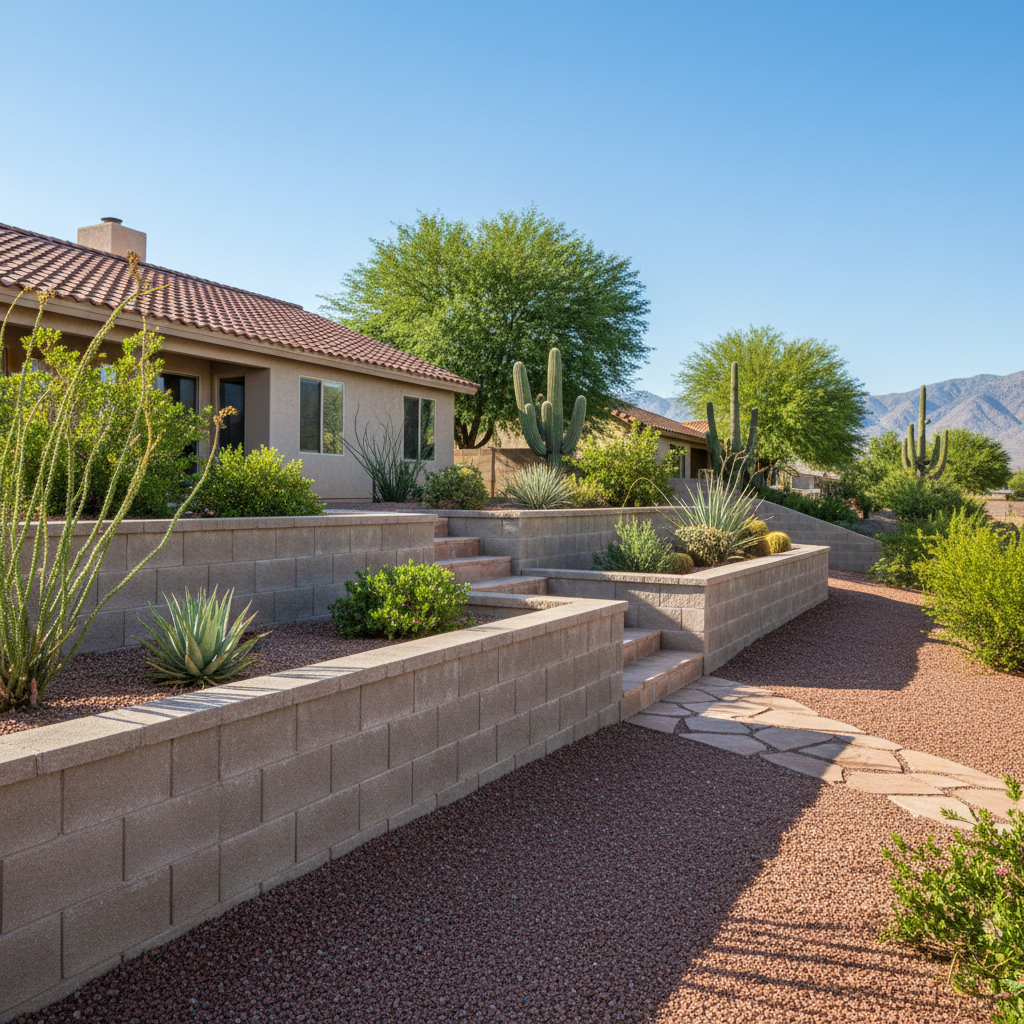
Alright, let's talk retaining walls. Here in Bullhead City, with our sloped lots and sometimes wild weather, a good retaining wall isn't just for looks; it's often a necessity. But I've seen my share of projects go south because folks didn't know what to look for. You're investing good money, so you want it done right. Here are the biggest blunders I see homeowners make, and how you can steer clear of them.
Mistake #1: Skipping the Soil Test
This is a big one, especially around here. Our soil isn't all the same. You might have sandy loam one lot over, and then heavy caliche or expansive clay on yours, especially closer to the river or in some of the older developments like Riviera. Building a heavy concrete wall on unstable or poorly understood soil is asking for trouble. It's like building a house on quicksand. The wall can crack, lean, or even fail completely, and then you've got a much bigger, more expensive problem on your hands. A proper soil test tells you what you're dealing with, and a good contractor uses that info to design a foundation that'll actually hold up.
Mistake #2: Underestimating Drainage Needs
Concrete retaining walls hold back a lot of earth. What else does that earth hold? Water. When we get those heavy monsoon rains, or even just regular irrigation, water builds up behind the wall. If there's no way for that water to escape, it creates immense hydrostatic pressure. That pressure can push a wall right over, or at least cause significant cracking and bowing. I've seen it happen. You need proper drainage – things like gravel backfill, perforated pipes (weep holes), and sometimes even a geotextile fabric. Don't let a contractor tell you it's not necessary; it absolutely is. It's cheap insurance against a total wall failure.
Mistake #3: Going for the Lowest Bid Without Due Diligence
Look, I get it. Everyone wants to save a buck. But when it comes to something as critical as a retaining wall, the cheapest bid is often the most expensive in the long run. I've seen contractors quote ridiculously low prices because they're cutting corners – using less rebar, thinner concrete, no proper drainage, or inexperienced crews. You need to ask for references, check their license with the Arizona Registrar of Contractors, and make sure they're insured. A legitimate contractor like Top Notch Concrete Solutions will give you a fair price for quality work, not a rock-bottom price for a headache. If a quote seems too good to be true, it probably is.
Mistake #4: Not Understanding Permits and Local Codes
This isn't just a suggestion; it's the law. In Bullhead City, most retaining walls over a certain height (often 4 feet, but check with the city's building department) require a permit. This means engineered drawings and inspections. Some homeowners try to skirt this, thinking they'll save time or money. Big mistake. If you build without a permit, you could face fines, be forced to tear it down, or have trouble selling your house later. A reputable contractor knows the local codes inside and out and will handle the permitting process correctly. Don't let anyone tell you a permit isn't necessary if the wall is significant.
Mistake #5: Focusing Only on Aesthetics, Ignoring Function
Of course, you want your retaining wall to look good. We all do! But its primary job is to hold back earth and water. I've seen folks get so caught up in the finish – the stamp, the color, the cap – that they overlook the structural integrity. A beautiful wall that's failing isn't beautiful for long. Make sure the contractor emphasizes the foundation, the rebar, the concrete mix, and the drainage first. The aesthetics are the icing on the cake, not the cake itself. A well-built, functional wall can always be made pretty, but a pretty wall that's falling apart is just a mess.
So, there you have it. Don't get caught out. Do your homework, ask the tough questions, and make sure you're working with someone who knows what they're doing. Your property, and your peace of mind, are worth it.